

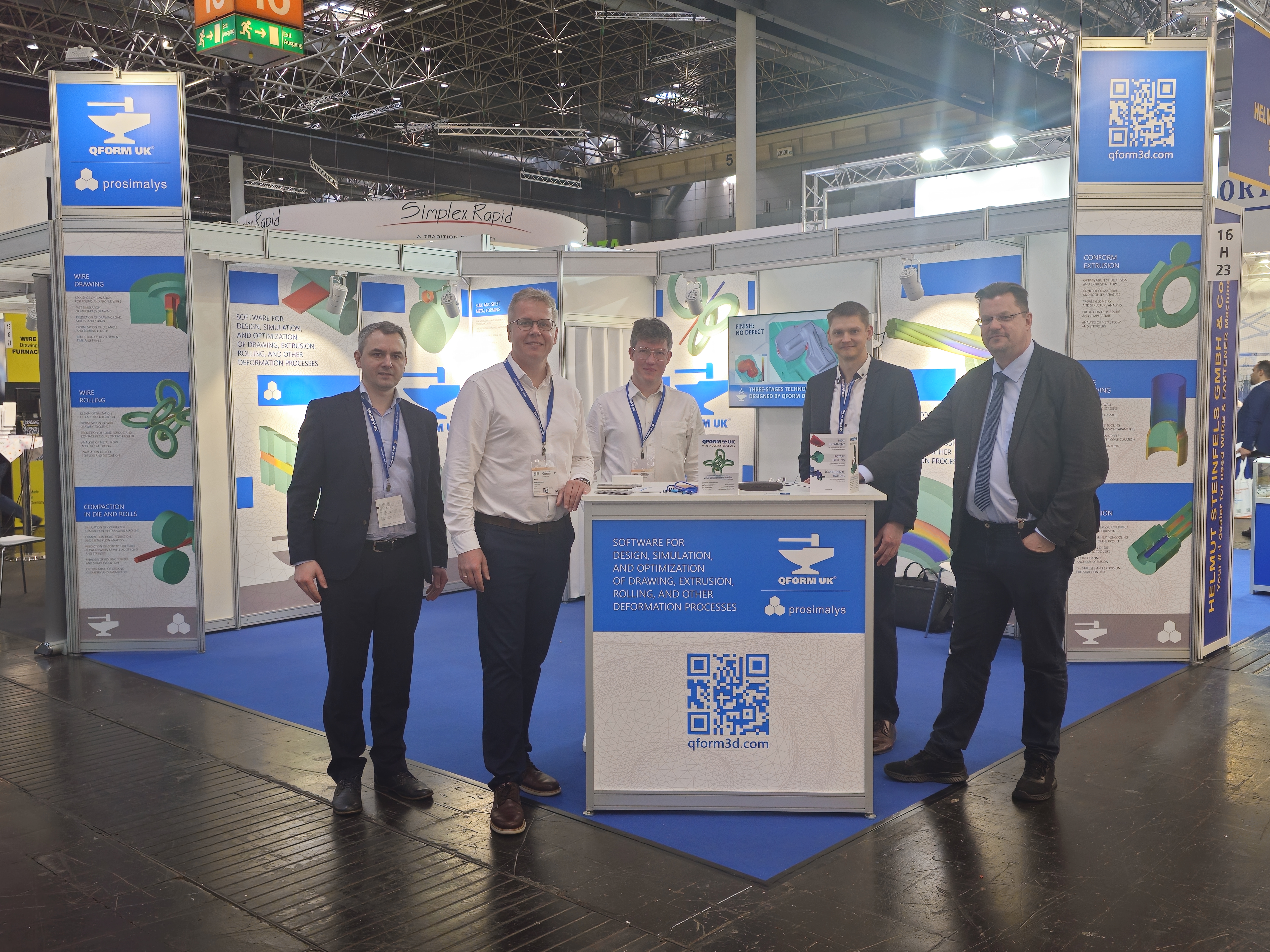
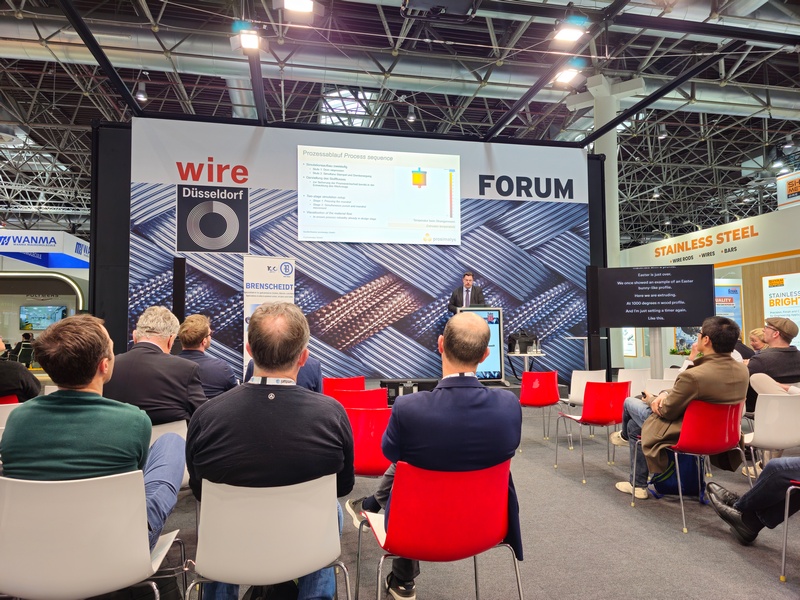
At the wire and Tube trade fair, held in Düsseldorf in April 2026, the QForm Group as Micas Simulations Ltd. and prosimalys GmbH participated with a booth and showed to the industry the benefits of simulating various metal forming processes using QForm UK software.
The wire manufacturing industry is currently growing rapidly and this is particularly evident at events such as Wire & Tube.
Aluminium and copper alloys belong to the same technological class of highly formable non-ferrous alloys. They share a number of important characteristics, including high ductility and many active slip systems, strong sensitivity to temperature and strain rate, and the fact that recrystallization/recovery are central to process optimization. In addition, these materials exhibit strong thermal-mechanical coupling. In general, they are easier to form than Ti and many Ni alloys.
However, despite these similarities, there are also significant differences between them. These include very different density, very different melting point / hot-working temperature, and different forming loads. They also differ in terms of oxide films and tribology, stacking-fault energy and recrystallization behaviour, as well as in the links between forming history and final properties.

WIRE DRAWING
Sequence optimization for round and profile wires
Fast simulation of multi-pass drawing
Prediction of drawing load, stress, and strain
Optimization of die angle and bearing length
Reduction of development time and trials
WIRE ROLLING
Design optimization of each roller profile
Optimization of wire drawing sequence
Prediction of load, torque, and contact pressure on each roller
Analysis of metal flow and profile filling
Evaluation of roll stresses and distortion
COMPACTION IN DIE AND ROLLS
Simulation of conductor compaction in stranding machine
Compaction ratio, reduction, and metal flow analysis
Prediction of contact pressure between wires as well as of load and stresses
Analysis of rolling torque and shape evolution
Optimization of groove geometry and parameters
CONFORM EXTRUSION
Optimization of die design and extrusion flow
Control of material and tool temperature
Profile geometry and structure analysis
Prediction of pressure and temperature
Analysis of metal flow and structure
TUBE DRAWING
Prediction of wall thickness and stresses
Prevention of damage and defects
Optimization of tooling design and expansion parameters
Evaluation of mandrels and die parameter configuration
Prediction of wrinkling and fracture risk
EXTRUSION
Metal flow analysis for direct and indirect extrusion
Prediction of heating/cooling and defects in the profile
Optimization of die design and tool life
Equal channel angular extrusion
Die stresses and extrusion pressure control
BULK AND SHEET METAL FORMING
Evaluation of bulk and sheet metal forming processes
Specific bending, punching, and cutting processes
Prediction of stress, strain, and temperature
Early detection of defects and high die stresses
Elimination of practical tests and trials
COLD FORMING
Dimensional analysis of the formed part to assess forming quality
Detection of forming defects, including evaluation based on damage criteria
Prediction of load and verification of cold forming press capacity
Estimation of tool life
Identification of critical stress zones in dies and punches
TUBE ROLLING
Special mesh adaptation in the deformation zone
Volume constancy throughout the deformation process
Accurate and fast calculation
Consideration of movement and support of all tools
Control of geometry and deformed metal structure
