

Bálint Gábriel, a student at Budapest University of Technology and Economics (Hungary), scored a convincing victory in the Olympiad’s most popular section — Hot Bulk Forging. But what does it take to win a six-hour competition under intense pressure? Gábriel explains how he honed his QForm skills, trained intensively in the weeks leading up to the competition, and overcame the most challenging parts of the task. He also shares what happened when he unexpectedly discovered the results.
My first encounter with the software was in the fall of 2022 when the Gillemot László College for Advanced Material Science Studies (GLSZ) organized a course held by Dr. József Bálint Renkó, who was also my preparation teacher for this competition. Following the course, even if not continuously, I used it several times because I had multiple subjects where this software came in very handy.
We started our preparation at BME by attending József's simulation and Olympiad preparation courses with other eager classmates. There were some who encountered the software for the first time, and some who had already worked with it before, just like me. However, it was excellent for refreshing my knowledge. Also, in one of our subjects called Metal Forming, we were given a hot bulk forging assignment that we had to work out similarly to the competition task. But the most intensive preparation was during the last weeks before the competition, when I practiced the specific steps based on the analogy of the aforementioned homework so they would go faster and more smoothly, and I combed through the standards one more time.
Dr. József Bálint Renkó, Dr. Attila Szlancsik and Professor András Reé helped me with my preparation.
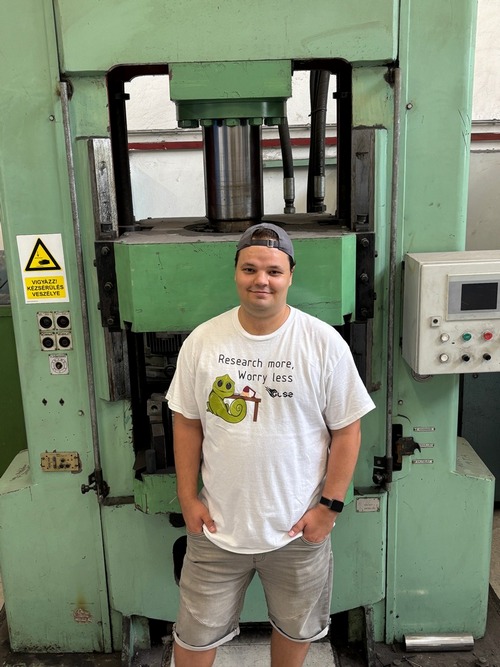
I heard about the competition itself at GLSZ from senior students. Since I have successfully participated in numerous competitions since I was a child because I loved competing, there was no question for me that I would enter this competition one day.
At first, I was really startled, wondering if I had actually won or if I was misreading something. I shouted out in the GLSZ office for someone to come over and check if I was seeing what I thought I was seeing. I was incredibly happy with the result, I was jumping for joy.
The hardest part for me was maintaining my focus for 6 hours. It was extremely difficult because I get distracted easily and can simply start working on other tasks. Fortunately, however, the stress caused by the competition situation and listening to upbeat Hungarian music helped a lot.
Regarding the task itself, I struggled with the positioning of the workpiece and the design of the preforming die cavities. I wanted to refine them much more, but I had to move on so I wouldn't spend too much time on them.
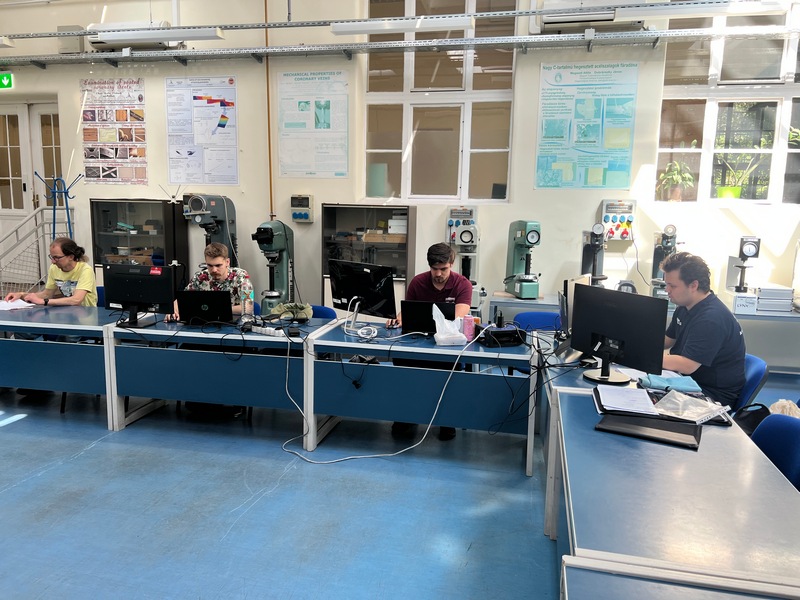
As a break, I was scrolling through Facebook for a bit when I came across the post about the results, which had been posted an hour earlier. It caught me completely off guard because I thought the results would be announced later. At first, I was really startled, wondering if I had actually won or if I was misreading something. I shouted out in the GLSZ office for someone to come over and check if I was seeing what I thought I was seeing. I was incredibly happy with the result, I was jumping for joy.
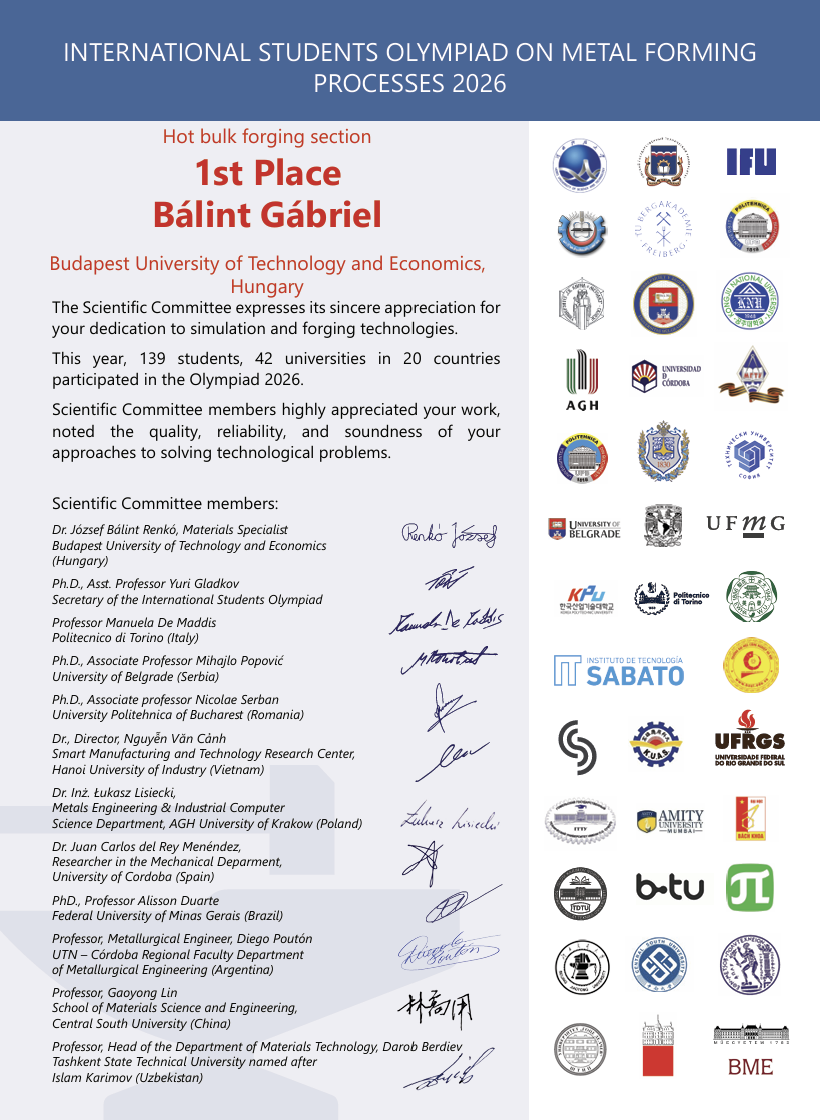
International Students Olympiad on Metal Forming Processes is held every year in April or May. Student Olympiad is our contribution to the education progress. The aim of the Olympiad is to build a professional community, to create a strong relationship between educational institutions and production companies. We are trying to motivate students to study modern simulation and manufacturing technologies. Students get an opportunity to build their professional portfolio, and companies get an opportunity to find talented and perspective specialists.
Read about the details of participating in the Olympiad, reports from previous years, and the rules on the Olympiad's official website.
