


Modul Maker learns from QForm UK finite element process histories paired with known target values from experiments and other data sources. Start with the simulations and measurements you already have, add data as it accumulates, then train and export a model for use in QForm UK.
No machine-learning programming is required.
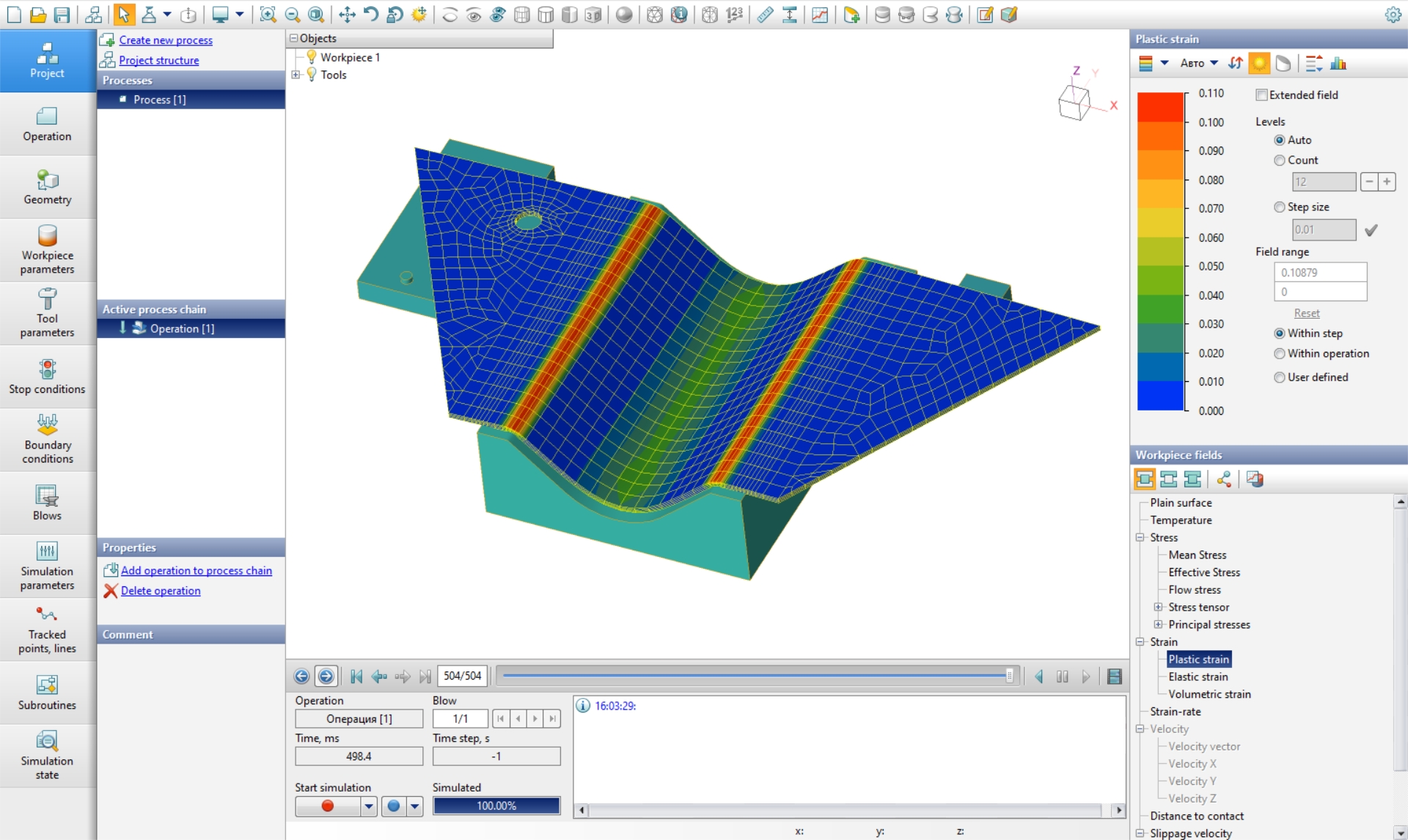
Model Maker pairs FE histories from tracked material points with known target values for the corresponding points and process checkpoints. The input is the sequence of process conditions over time; the output is a trained model that predicts the selected property. A guided workflow takes you from input selection and data pairing to training and export for QForm UK.
• Synchronise measurements with tracked material points and process checkpoints.
• Select input variables and targets, then assemble and normalise the dataset from available histories.
• Configure and train the sequence model.
• Export the model for deployment in QForm UK and apply it to new process simulations.
Properties can include grain size, recrystallised fraction, phase fraction, hardness or other measured material properties.
Material properties depend on the full thermomechanical path, including heating, deformation, holding and cooling. Two material points can finish with the same temperature and strain but have different microstructures if they reached that state by different routes. Model Maker therefore learns from the FE history of each tracked point instead of relying only on final field values.
When the data you already have do not cover the process histories you need, TMTS can replay selected production-like heating, deformation and holding histories under controlled laboratory conditions. Tests can be interrupted at defined checkpoints so intermediate material states can be measured and added to the training dataset.
• Programmable heating, deformation, holding and quenching reproduce selected thermomechanical histories.
• Tests can be interrupted at defined checkpoints to preserve intermediate material states.
• The resulting specimens can be measured for microstructure and material properties at those checkpoints.
In QForm UK, a selected TMTS route can be modelled as a sequence of FE operations. The resulting histories at tracked material points can be paired with corresponding measurements at defined checkpoints, extending the data available for model training and evaluation.
With Model Maker, process engineers can turn accumulated experiments and QForm UK calculations into predictive models for selected material properties. Export a trained model to QForm UK and use it to investigate other forming processes.
